


We stand behind the quality of our products with commitment to ensuring you're satisfied with your purchase.
How does it work?
How does it work?
OptiFlow™ crosses the BRB (unlike lutein that gets blocked) and restores blood flow to your ciliary muscle—the tiny muscle that focuses your eyes all day.
When that muscle gets clamped from hours of screen time, it suffocates. That's the deep ache you feel. Astaxanthin "unkinks the hose," flooding oxygen back in so the muscle can relax, recover, and refocus smoothly again.
It's like physical therapy for your eyes—from the inside.
What NightGuard™ Helps With
What NightGuard™ Helps With
✓ The 3 PM eye crash that kills your productivity
✓ Burning, gritty eyes by afternoon
✓ Blurry vision when switching between screens
✓ Headaches radiating from behind your eyes
✓ Constant eye drop dependency
✓ Slow refocusing (the "Focus Glitch")
If your eyes feel exhausted before you do, this is for you.
NightGuard™ Astaxanthin
NightGuard™ Astaxanthin - Made for People Who Refuse to Give Up Their Keys
Drive When You Want
See Through Rain & LED Headlights
Shorten Recovery Time After Glare
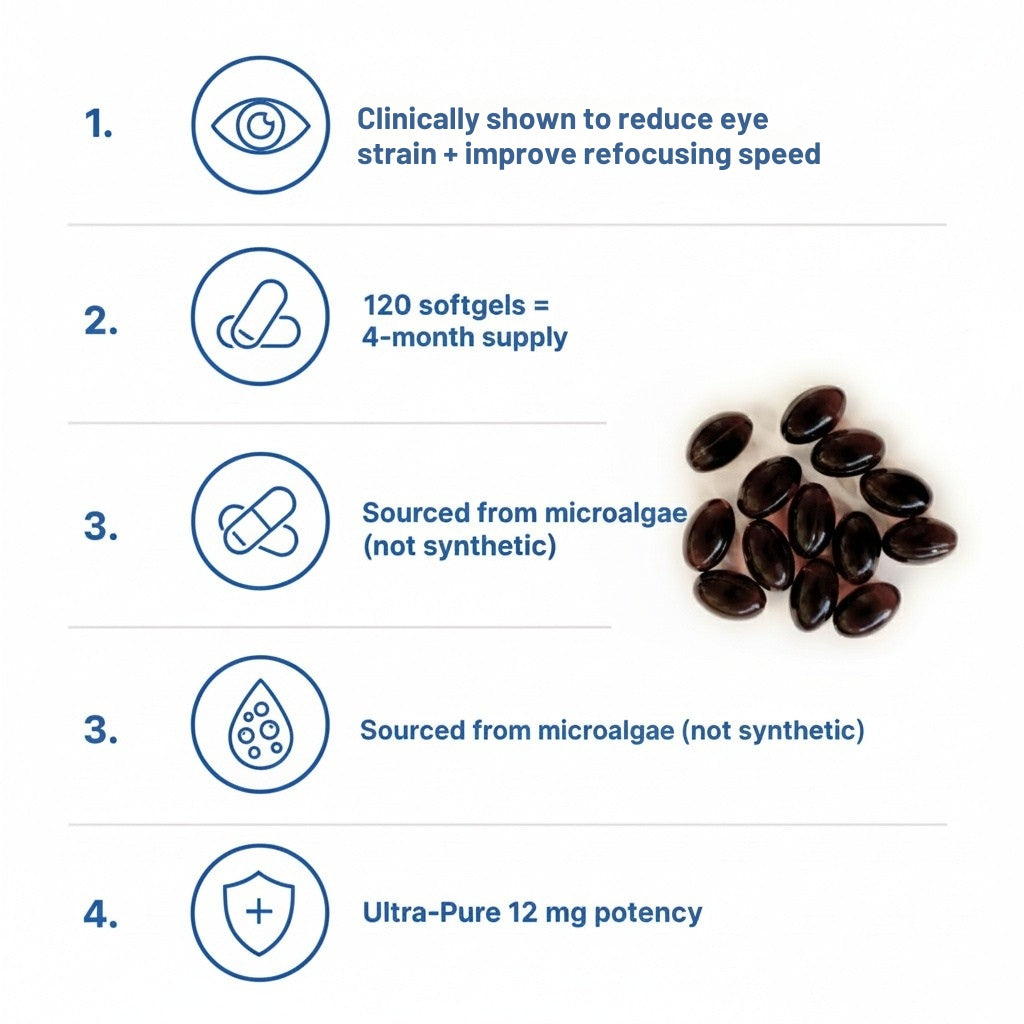
12mg Clinical Dose
Keep Your Keys, Keep Your Freedom
If night driving has slowly changed your life, this is how you start taking it back.. without asking anyone for help
Couldn't load pickup availability

Marcus T
"I tried everything—new glasses, eye drops, even those yellow night-driving lenses. Nothing helped with the blinding headlights. After 6 weeks on NightGuard, I drove to my grandson's basketball game at 7 PM without white-knuckling the wheel. The starbursts are almost gone, and I'm not terrified when trucks pass me anymore. I finally feel like I have my freedom back."
In stock
Arrives
Why Astaxanthin?
Why Astaxanthin?
Most vision supplements focus on protecting your eyes during the day. But they do nothing for the moment that matters most: when you're driving at night and headlights hit you.
That's because the problem isn't damage—it's recovery speed.
When LED headlights blind you, your eye's photoreceptors (light-detecting cells) get "frozen." In younger eyes, they snap back instantly. But as we age, these cells become slower and weaker. This creates the dangerous "Recovery Gap"—that 5-9 second window where you're driving blind.
Astaxanthin is the only nutrient clinically proven to speed up photoreceptor recovery.
It crosses the blood-retinal barrier and penetrates directly into the cells responsible for adapting to light and dark. Studies show it:
- Reduces glare sensitivity by up to 46%
- Cuts visual recovery time after bright light exposure
- Improves contrast sensitivity in low-light conditions
Unlike blue-light glasses (which make everything darker) or standard lutein supplements (which only protect the macula), Astaxanthin targets the speed of your visual reset—giving you back the "snap" your eyes used to have.
What's Inside
What's Inside
Each Softgel Contains:
- 12mg Natural Astaxanthin (from Haematococcus pluvialis algae)
Clinical dose proven effective in studies
6,000x more potent than Vitamin C for eye protection - Organic Sunflower Oil (for maximum absorption)
Astaxanthin is fat-soluble and requires healthy fats to work
What's NOT Inside:
- No synthetic fillers
- No artificial colors
- No GMOs
- No gluten or dairy
Purity Tested: Third-party verified for heavy metals and contaminants.
When Will I See Results?
When Will I See Results?
Week 1-2: The "Relaxation Phase"
Most people notice reduced eye strain and less "tired eye" feeling at night. You may find you're not squinting as much in dim lighting.
Week 3-4: The "Clarity Shift"
This is when the glare reduction becomes noticeable. Headlights still bother you, but the "starburst" effect is smaller. Your eyes recover faster after bright lights pass.
Week 6-8: The "Confidence Return"
You'll notice you're driving more relaxed at night. You can see road signs sooner. The panic when a truck passes you is gone. Many people report driving in the rain again for the first time in years.
Week 12+: The "New Normal"
Your eyes feel 10 years younger. You say "yes" to evening invitations without checking the sunset time. You stop planning your entire day around avoiding night driving.
Clinical studies show measurable improvement in 4 weeks, with peak benefits at 12 weeks.
Note: Results vary. Some people see changes in days; others need 6-8 weeks. Consistency is key.
Who Can Use It?
Who Can Use It?
NightGuard is designed for anyone who:
- Struggles with glare from oncoming headlights
- Avoids driving at night due to vision concerns
- Has trouble seeing in dim restaurants or dark hallways
- Experiences "starbursts" or "halos" around lights
- Feels like their eyes take forever to adjust between light and dark
- Wants to maintain their independence and keep driving
Safe for:
- Adults of all ages (though most effective for 55+)
- Those with cataracts (post-surgery or pre-surgery)
- People already taking other vision supplements (lutein, zeaxanthin, etc.)
Not recommended if you:
- Are pregnant or nursing
- Are allergic to algae or shellfish
- Are taking blood thinners (consult your doctor first)
Drug Interactions: Astaxanthin is very safe, but if you're on prescription medication, check with your doctor before starting any new supplement.
NightGuard™ Astaxanthin


The Clinical Research Supporting Astaxanthin
Results from published studies on astaxanthin supplementation in screen users after 4-12 Weeks of Daily Use:
54%
Reduction in glare disability (improved ability to see during and after bright light exposure)
46%
Improvement in photostress recovery time (how fast your eyes "reset" after headlights)
37%
Enhanced contrast sensitivity in low light (ability to see road edges, lane markers, and obstacles in the dark)
90%
Reported improved night driving confidence (participants felt safer driving after sunset)
20%
Faster visual adaptation between light and dark environments (measured reduction in dark adaptation time)
*Based on an Internal Study of NightGuard Users

THE LED HEADLIGHT BATTLEFIELD: What They're Not Telling You About "Getting Older"
If you've started timing your life around sunset, you need to read this.
Maybe it started with declining that dinner invitation that ends after dark.
Or the white-knuckle grip when a semi's headlights turn your windshield into a blazing wall of light.
Perhaps you've said "I just prefer not to drive at night anymore"—as if it were a choice.
Here's what nobody's telling you:
This isn't about "getting older." And it's not about your eyes getting weaker.
Your Eyes Were Never Designed For This
In the last decade, automakers switched to high-intensity LED beams that are 3-5 times brighter than the halogens you grew up with.
That blue-spectrum light scatters across your cornea like a camera flash—creating those starbursts that turn every headlight into a dozen blazing spikes.
But the blinding glare isn't even the real problem...
The 9-Second Blind Spot
When LED light hits your retina, it "stuns" your photoreceptor cells.
Young eyes recover in 2 seconds.
Your eyes? 7 to 9 full seconds.
At 60 mph, that's 800 feet of driving blind. Nearly three football fields—with no view of lane markers or brake lights ahead.
But here's what changes everything:
It's Not Weakness—It's Starvation
After 60, blood flow to your retina drops 25%. Your natural blue-light filter thins. Cellular recovery slows.
Every LED exposure weakens your photoreceptor cells further. The Recovery Gap widens.
Until one night: This isn't worth the risk.
Your optometrist never mentioned this because standard tests don't measure recovery speed.
Blue-blocker glasses can't fix it because the problem isn't what's hitting your eyes—it's what's missing inside them.
41% of drivers over 65 now avoid night driving. That's over 20 million Americans living by the "Silent Curfew"—timing their lives around avoiding roads after dark.
But what if the solution wasn't about glasses or prescriptions?
What if it was about giving your photoreceptor cells the one thing they're desperately missing—the fuel to snap back faster?

THE "RECOVERY ACCELERATOR" YOUR EYES have Been Waiting For
Remember how we said your photoreceptor cells are starving?
Here's what they're starving for: Astaxanthin.
It's a deep-red carotenoid found in wild salmon and ocean algae—nature's most potent antioxidant for eye tissue.
And here's why it changes everything for night driving:
Astaxanthin Does Two Things No Other Supplement Can
First: It crosses the blood-retinal barrier.
Most nutrients can't reach your photoreceptor cells—they're blocked by your eye's protective membranes. Astaxanthin slips right through and embeds itself directly into those light-sensing cells.
Think of it as internal armor against LED assault.
Second: It speeds cellular recovery.
When LED light "stuns" your photoreceptors, they need to chemically reset before they can process light again. Astaxanthin accelerates that reset process—cutting your Recovery Gap from 9 seconds down to 3... 4... sometimes back to 2.
The Clinical Evidence
In multiple peer-reviewed studies, 12mg of astaxanthin daily:
→ Reduced glare disability by 46%
→ Improved visual recovery time after bright light exposure
→ Enhanced contrast sensitivity in low-light conditions
→ Decreased eye fatigue during prolonged visual tasks
But here's what matters most:
Participants reported feeling confident driving at night again. Seeing road signs sooner. No more panic when trucks pass.
Why You've Never Heard of This
Lutein and zeaxanthin get all the attention because they protect your macula—the part of your eye responsible for central vision.
But they do nothing for glare recovery or visual reset speed.
Astaxanthin works deeper—in the photoreceptor layer where light adaptation actually happens.
It's not about what you see. It's about how fast your eyes adjust between light and dark.
That's why optometrists don't mention it. Standard vision tests measure clarity, not recovery speed.
The Difference You'll Actually Feel
Week 1-2: Less squinting in dim light, eyes feel less strained
Week 3-4: Starbursts shrinking, faster recovery after oncoming headlights
Week 6-8: Driving to that evening event without the stomach knot, seeing lane markers in rain
Week 12+: The grip on the wheel loosens. The curfew lifts.
This isn't about perfect vision.
It's about giving your photoreceptor cells the internal protection and recovery fuel they need to handle modern roads.
So you can stop planning your life around daylight.
And start accepting invitations again—no matter what time they end.
Us vs What You're Told to Do
Why NightGuard™ Works When Blue-Blockers and Eye Vitamins Don't
|
Primera
Original
|
Others
|
|
|---|---|---|
| Speed Glare Recovery Time | ||
| Reduces LED Light Harshness | ||
| Works Internally | ||
| Reduces Vision Darkening and Distortion | ||
| Backed by Science |
|
NIghtGuard™
Original
|
Lutein Prescription
|
Bluelight Glasses
|
Prescription Glasses
|
|
|---|---|---|---|---|
| Helps With Eye Fatigue | Yes | ⚠️ Uncertain | ⚠️ Uncertain | |
| Supports Eyes During Long Work Sessions | Yes | ⚠️ Unclear | ||
| Supports Visual Endurance | Yes | ⚠️ Uncertain | ||
| Simple Internal Solution | Yes | ⚠️ Uncertain | ||
| Made for High Performers | Yes |
WHY SENIORS WHO CAN'T SEE AT NIGHT CHOOSE ASTAXANTHIN
Your ability to drive confidently after dark depends on recovery speed, not just protection.
While blue-blocker glasses filter light and standard eye vitamins protect your macula, astaxanthin supports the internal structures doing the actual work—your photoreceptor cells. Clinical research on visual adaptation. Third-party tested. No proprietary blends.
Frequently Asked Questions
I tried lutein for months. Why would astaxanthin be different?
I tried lutein for months. Why would astaxanthin be different?
Lutein and zeaxanthin protect your macula—the central part of your retina responsible for sharp, detailed vision. They're excellent for preventing age-related macular degeneration, but they don't address glare recovery speed.
Astaxanthin works in the photoreceptor layer where light adaptation actually happens. It's the only carotenoid that crosses the blood-retinal barrier to reach these cells and accelerate their recovery after bright light exposure. Think of lutein as protecting your eye's "camera sensor" while astaxanthin speeds up your eye's "shutter speed."
Many of our customers continue taking their lutein supplements alongside NightGuard™ for comprehensive eye support.
Are there any side effects?
Are there any side effects?
Our formula is 100% natural and well-tolerated. However, as with any supplement, if you have allergies or pre-existing conditions, consult your healthcare provider before use.
Will this interfere with my medications?
Will this interfere with my medications?
Astaxanthin is generally well-tolerated and safe alongside most supplements. However, if you're on blood thinners (warfarin, aspirin), immunosuppressants, or blood pressure medications, consult your doctor first. It doesn't interfere with eye drops or glaucoma/cataract medications. Email us if you want to verify your specific medications.
Can I just wear blue light glasses?
Can I just wear blue light glasses?
Blue-blockers darken everything—including road signs and lane markers—and many people see worse at night with them. More importantly, they don't fix the core problem: your photoreceptor cells still take 7-9 seconds to recover after LED exposure. NightGuard™ accelerates that cellular reset from the inside without distorting your vision.
How do I know it's actually working?
How do I know it's actually working?
Week 2-3: Less squinting, reduced eye fatigue by evening. Week 4-6: Smaller starbursts, faster light-to-dark adjustment. Week 6-8: Looser grip on the wheel, road signs visible sooner, less anxiety before evening drives. If you don't notice improvement in glare recovery by week 8, we'll refund you—no questions asked.
What if i just avoid night driving instead?
What if i just avoid night driving instead?
That's valid. But it often starts with "just avoiding" night driving and gradually expands—declining events, depending on others, missing activities. NightGuard™ gives you the option to reclaim independence on your terms. You don't have to drive at night, but having the choice makes a difference. 60-day money-back guarantee means zero risk.